

In a seller’s market, it’s not uncommon for a house to sell for more than it’s worth. A home appraisal, which is a report that estimates the current market value of a house, is used by mortgage lenders to determine whether the property they’re financing is worth the price being paid. If the purchase price exceeds the appraised value, lenders are required to base the loan on the lesser of the purchase price or the appraised value.
Here are a few home appraisal Q&As to consider before applying for a mortgage loan.
How do I get a home appraisal?
While the borrower is typically in charge of covering the cost, your lender will be the one to order the home appraisal. The cost of an appraisal depends on the size and location of your home. The appraiser will provide an unbiased perspective on the market value of your home. After scheduling an appointment, they will inspect the home and note its features in the appraisal report to send back to your lender. The estimated home value and its loan amount are determined through this process.
What factors affect a home’s appraised value?
Several factors impact a home’s appraised value, including:
- Size
- Location
- Amenities
- Comparable properties
- Improvements or remodels
What is a loan-to-value ratio?
A loan-to-value ratio is a percentage calculated by dividing the amount borrowed in a mortgage by the appraised property value. If your loan-to-value ratio is 70%, that means you have taken out a loan for 70% of your home’s market value. This ratio measures the financial risk of a mortgage and is a large factor in a lender’s decision to approve you for a home loan.
Will I still get a mortgage if I buy above the appraised value?
Many lenders take market conditions into account when making lending decisions. In a strong seller’s market, they may approve loans for buyers whose offers surpass appraised values. Just know your mortgage terms may need to be adjusted, depending on the new loan-to-value ratio.
Here’s an example of how this works:
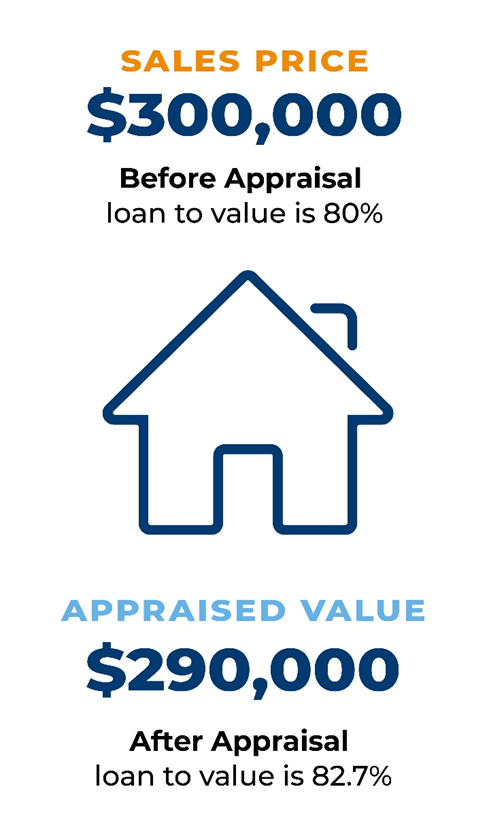
- You make an offer of $300,000 on a home, and the seller accepts.
- The house is appraised for $290,000.
- Your original plan was to put 20% down, making your loan-to-value 80%. However, the loan-to-value is always based on the lesser of purchase price or appraised value, whichever one is less. Because of the appraised value, your loan-to-value is actually 82.7%. This leaves you a few options:
- You can pay the difference in cash.
- You can buy mortgage insurance. If you have a high credit score, single premium mortgage insurance could be a great option. This may allow you to keep your down payment the same while still having the loan originated with mortgage insurance.
- You can request the seller to reduce the purchase price or possibly split the difference.
Appraisal contingencies
You have the option of including an appraisal contingency in your offer on a home, meaning you reserve the right to negotiate or fully retract your purchase agreement if the appraisal ends up being lower than the selling price. Keep in mind in a strong seller’s market, a home seller may favor offers with no contingencies.
Contact your lender to help assess your options and find a solution to fit your homebuying needs.